
What is the GLiNER Model? (General Purpose LLM vs. GLiNER)
As data processing technology evolves rapidly, accurately structuring essential 'Facts' from vast documents is becoming more important than simply generating text. Today, we'll examine the GLiNER model and how it differs from general-purpose LLMs.
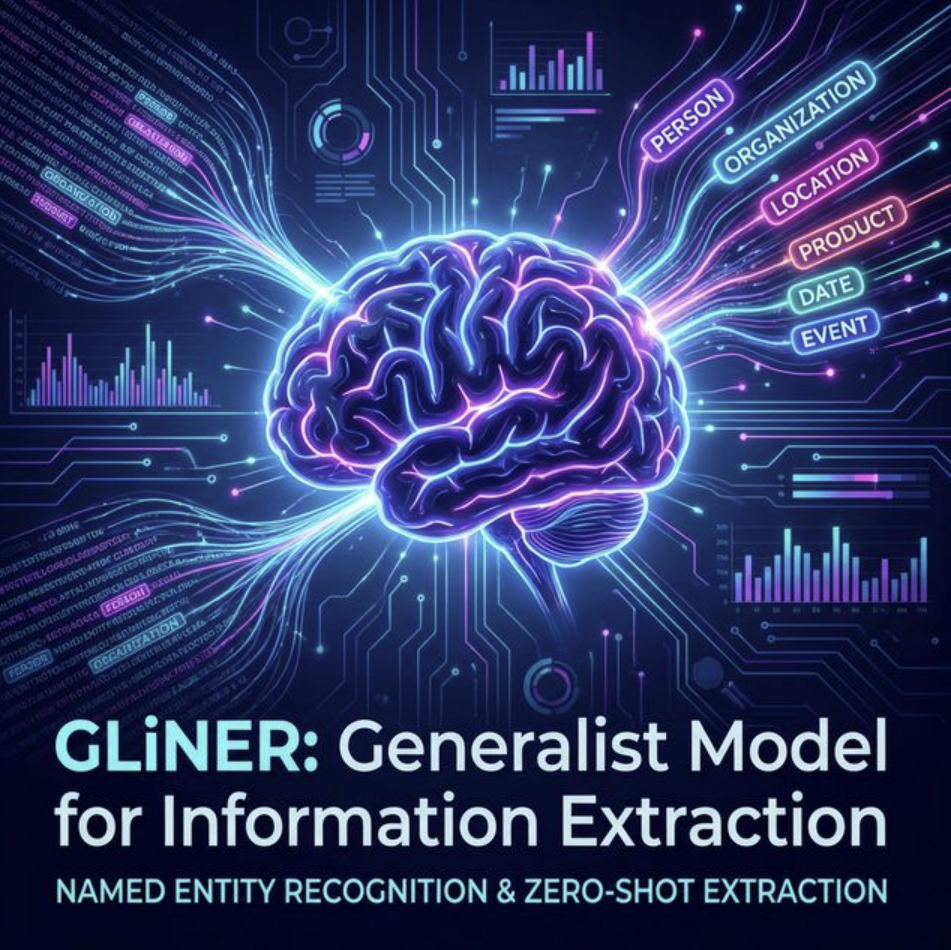
1. What is GLiNER?
GLiNER (Generalist Model for Information Extraction) is a 'General-purpose Lightweight Information Extraction Model' designed to extract any type of entity (names, organizations, dates, technical terms, etc.) on the fly, as the name suggests.
While traditional Named Entity Recognition (NER) models could only find pre-trained categories, GLiNER features exceptional Zero-shot capability, immediately understanding and finding new tags defined by the user within the text.
2. General-Purpose LLM vs. GLiNER: Core Comparison
Many ask, "Can't I extract information with LLMs like GPT?" However, there are decisive differences in terms of business field and data structuring.
| Category | General-Purpose LLM (Generative) | GLiNER (Extractive) |
|---|---|---|
| Core Mechanism | Predicts the next word to generate conversation | Matches specific spans within text to extract |
| Safety (Reliability) | Hallucination Risk exists | Fact-based Extraction based on source (Safe) |
| Processing Speed | Heavy and slow due to token generation | Extremely light and fast for extraction optimization |
| Cost & Resource | Requires high GPU resources and incurs API costs | Cheap enough to run even in CPU environments |
| Accuracy (NER) | Understands context well but may miss or distort | Extremely precise in entity boundary and matching |
3. Why GLiNER Now? (Latest Research and Real Cases)
✅ Recent Research: The Shadow of Giant Models (Nature Medicine, 2025)
According to a study published in Nature Medicine (s41591-025-04074-y), concerns have been raised that when the general public receives help from LLMs in sensitive areas like medical environments, performance can actually be lower than LLM alone. This suggests that the probabilistic responses of LLMs are difficult for humans to trust 100%.
In these Mission-Critical domains, it's crucial to ensure the integrity of facts through extraction-based models like GLiNER rather than probabilistic generation.
✅ Practical Ecosystem: GitHub Open Source Cases
GLiNER is not just a research paper but is building a powerful open-source ecosystem. The urchade/GLiNER repository offers the following extensibility:
- gliner-spacy: Integrates with spaCy, the industry-standard NLP library, for immediate enterprise application.
- HuggingFace Integration: Supports multilingualism, including Korean, through dozens of fine-tuned models.
- ONNX Conversion: Enables high-speed extraction on mobile or edge devices by light weighting the model.
4. The Evolution: GLiNER2 (Unified Information Extraction)
The recently released fastino-ai/GLiNER2 has evolved into Unified Information Extraction (UIE), moving beyond simple entity extraction.
🎯 Key Differentiators
- 4-in-1 Versatile Model: A single model performs entity extraction (NER), text classification, relation extraction, and structured data (JSON) conversion in one pass.
- Schema-Based Extraction: It accepts detailed descriptions for each field as input, providing much higher accuracy in specialized domains such as healthcare and legal.
- Local & CPU First: Runs 100% locally with zero external dependencies and ensures lightning-fast inference on standard CPUs, perfect for privacy-sensitive enterprise environments.
5. Why GLiNER Achieves Both "Safety" and "Speed"
✅ Structural Safety: Hallucination Zero
General-purpose LLMs create "plausible" sentences based on probability. In contrast, GLiNER finds things 'as they are' by measuring similarity between spans of the source text and labels. This structure makes it impossible to fabricate content, making it suitable for environments where data reliability is the top priority.
✅ Maximized Efficiency (CPU Runnable)
Even without hundreds of billions of parameters, it outperforms LLMs in specific tasks (NER/Extraction). This offers massive advantages in terms of infrastructure cost reduction and data security (On-premise execution).
5. Hands-on Guide (5-Minute Practice)
Test GLiNER in your local environment with this quick guide.
1) Preparation
Ensure Python is installed, then install the GLiNER library:
pip install gliner gliner2
2) Basic Practice (GLiNER v2.1)
The most common entity extraction example.
from gliner import GLiNER
model = GLiNER.from_pretrained("urchade/gliner_medium-v2.1")

text = "Patient (John Doe, 45y) reported symptoms of pneumonia on 2026-02-12."
labels = ["Person", "Date", "Medical Condition"]

entities = model.predict_entities(text, labels, threshold=0.5)
for entity in entities:
    print(f"{entity['text']} => {entity['label']}")
[Expected Output]
John Doe => Person
2026-02-12 => Date
pneumonia => Medical Condition
3) Advanced Practice (GLiNER2: Unified Schema Extraction)
With GLiNER2, you can obtain relations and structured JSON data in one pass.
from gliner2 import GLiNER2

# 1. Load the next-gen unified model
extractor = GLiNER2.from_pretrained("fastino/gliner2-base-v1")

# 2. Text to analyze
text = "Apple CEO Tim Cook announced iPhone 15 in Cupertino. Tim Cook works for Apple."

# 3. Perform Unified Extraction (Using Schema object)
schema = (extractor.create_schema()
          .entities(["company", "person", "product", "location"])
          .relations(["works_for"]))

result = extractor.extract(text, schema)
print(result)
[Expected Output]
{
  "entities": {
    "company": ["Apple"],
    "person": ["Tim Cook"],
    "product": ["iPhone 15"],
    "location": ["Cupertino"]
  },
  "relation_extraction": {
    "works_for": [["Tim Cook", "Apple"]]
  }
}
6. Closing
If you need an "AI that finds accurately" beyond just an "AI that speaks well," GLiNER is the most powerful alternative. Specifically for companies where fact-based structured data is an asset, it will become an essential tool.